
Contact Dayton Door Sales Today!
Thank you! Your submission has been received!
Oops! Something went wrong while submitting the form.


A garage door that won’t go up can bring your entire day to a halt, whether you’re trying to get to work, secure your home, or simply park your car. While the problem can feel urgent (and expensive), the reality is that many garage door issues have straightforward causes and, in some cases, quick fixes you can handle yourself. From simple power and sensor problems to more serious mechanical failures like broken springs, understanding why your garage door won’t open is the first step toward solving it safely and efficiently.
In this blog, we’ll break down the most common reasons garage doors refuse to go up, explain what you can check on your own, and help you know when it’s time to call a professional, so you can get your door working again with confidence.

When your garage door won’t open, it’s natural to worry about costly repairs. The good news? In most U.S. homes built between about 1995 and 2025, door failures fall into a few predictable categories. Before you panic, let’s walk through the most common causes so you can quickly narrow down what’s going on.
Here are the core issues that cause a garage door to stop going up:
If the opener runs but the door barely moves, broken springs or a disconnected trolley are likely. If nothing happens at all, power issues should be your first check. Many homeowners find clarity by learning more about garage door repairs and what you need to know to fix common issues, especially when deciding whether a problem is manageable or requires professional service.
The following sections will walk through each cause one by one, starting with the simplest checks you can safely do and working toward issues that require professional help.

If your garage door won’t budge even though the opener seems to be working, there’s a strong chance you’re dealing with a broken spring. Torsion and extension springs carry most of the door’s weight, a standard double garage door can weigh 150 to 300 pounds. Once a spring breaks, the opener motor simply cannot lift that heavy weight on its own.
|
Spring Type |
Location |
What to Look For |
|
Torsion springs |
Mounted horizontally above the door on a metal shaft |
Center bracket, winding cones on each end, coils wrapped tightly |
|
Extension springs |
Mounted along the horizontal tracks on each side |
Long springs that stretch when door closes, safety cables running through them |
Many homeowners report hearing a loud noise from the garage, often described as a bang or gunshot sound, right before the door stopped working. This is the spring snapping. Other signs include:
Attempting to replace or wind springs yourself can be extremely dangerous. Many homeowners underestimate the risks involved, which is why understanding the dangers of DIY garage door repair is critical before attempting any mechanical fixes.
Even if you’re handy around the house, do not attempt to wind or replace springs yourself unless you’re properly trained and equipped. Torsion springs store tremendous energy under high tension, enough to cause severe injury if they release unexpectedly. This is one repair where calling a professional is the only safe option.
What you CAN safely do: With the door closed and garage lights on, perform a visual inspection from the floor. Look for obvious gaps in the spring coils or hanging cable. Then contact a service technician to match the correct cycle-rating and size for your replacement springs.
Here’s some encouraging news: many “won’t go up” complaints turn out to be electronics and safety sensor issues rather than major mechanical failures. These problems are often fixable by the homeowner in just a few minutes.
The photo eye sensors are small devices mounted about 4 to 6 inches above the floor on either side of the door track. They send an infrared beam across the opening, if anything blocks that beam, the safety feature kicks in and prevents operation.
Check for these issues:
Quick fix: Clean both sensor lenses with a soft cloth. Make sure nothing is in the door’s path. Gently adjust sensor positions until both LEDs show solid lights.
Dead or weak batteries are among the most common reasons a garage door won’t open from the remote control. Here’s how to troubleshoot:
Radio frequency interference from Wi-Fi routers, LED lights, or nearby electronics can also disrupt signals in modern openers. Try standing closer to the door when pressing the remote, or temporarily turn off suspect devices to test.
Dead batteries, lost programming, or tripped breakers are common culprits. Power surges can also affect opener electronics, which may raise questions about whether homeowners insurance covers garage door repairs, particularly when damage results from electrical events or storms.
If there are no lights and no sounds when you push the wall button, the opener may not be receiving power.
Check these items:
|
What to Check |
How to Test |
|
Ceiling outlet |
Plug a lamp into the outlet where the opener connects |
|
Circuit breaker |
Look for a tripped breaker in your home’s electrical panel |
|
GFCI outlet |
Reset any GFCI outlets in the garage or nearby laundry room |
|
Power cord |
Make sure the opener’s plug hasn’t been accidentally disconnected |
If the outlet is dead and resetting the breaker doesn’t help (or it keeps tripping), you may have a deeper electrical issue that needs an electrician.
Even if the opener and springs are working fine, your garage door still needs to travel smoothly in its metal tracks. Bends, obstructions, and worn hardware can all stop a door from opening properly.
A misaligned track creates friction that prevents smooth door’s movement. Look for:
Common causes of track damage include:
With the door closed, visually inspect both tracks from floor to ceiling:
Cracked plastic rollers, rusted steel rollers, or loose hinge bolts can cause jerky movement and sometimes prevent the door from reaching fully open. Signs include:
Maintenance tip: Use a silicone-based spray lubricant on metal rollers, hinges, and bearings twice a year. Avoid spraying the tracks themselves, lubricant there can attract dirt and cause slipping.
Important: If the door has come partially off its tracks or panel sections are visibly twisted, stop using the opener immediately. Forcing a stuck door can fold sections and require full door replacement.
Sometimes the simplest oversights cause the biggest headaches. An engaged lock, activated vacation mode, or an unlatched opener trolley can make an otherwise healthy system refuse to open.
Many older steel and wood garage doors have a manual lock, typically a slide bolt or T-handle lock that secures the door from inside. If the door hums briefly then stops, or moves an inch and quits, check for:
Disengage any lock before attempting to operate the opener again. Repeated cycling against a locked door can strip the opener’s internal gears.
The red cord hanging from the opener rail is the emergency release cord. When pulled straight down, it disconnects the trolley from the opener carriage so you can move the door manually during power outages.
The problem: If someone pulled this cord and never re-engaged it, the opener will run but the door stays put. You’ll hear the motor and see the chain or belt moving, but the door doesn’t budge.
To reconnect (on most modern openers):
Many wall consoles introduced after about 2010 include a lock or vacation mode. If the lock indicator light is on, remotes and keypads are disabled while the wall button may still work.
To fix: Press and hold the lock button on your wall panel for several seconds until the indicator light goes out.
If the door starts up then immediately stops or reverses, the opener may think it hit an obstruction. The limit switch and force sensitivity settings control how far the door travels and how much resistance triggers a reversal.
Homeowner guidance:
After power outages or lightning storms, remotes and keypads sometimes lose programming. If the wall button works but wireless controls don’t, try reprogramming them following your opener’s manual.
The opener is the brain and brawn of your automatic garage door system. If it’s failing internally, the door may refuse to move even when the springs and hardware are perfectly fine.
Many chain-drive and belt-drive openers use a plastic worm gear meshed with a metal drive gear. Over years of use, or if the opener repeatedly strains against a heavy or jammed door, that plastic gear can strip completely. When this happens, the motor runs, but the chain or belt doesn’t move. Many homeowners ask how long garage door openers last and what affects their lifespan. Most openers last 10–20 years, but heavy daily use, poor maintenance, and repeated strain from unbalanced doors can shorten that window significantly.
Openers older than 15 to 20 years (pre-2010 models) are more likely to experience:
What you can safely do: Unplug the opener, remove the cover, and visually inspect for obviously stripped gears or burnt electronics. Actual motor or gear replacement is usually best left to a technician.
Consider replacing your opener entirely if:
Modern openers in 2025 offer conveniences that may justify the cost of replacement: battery backup (so the door opens during power outages), smartphone control, LED lighting, and significantly quieter operation.
Safety first: This procedure is only for doors that appear intact, no broken springs or cables, no bent tracks. If the door looks crooked, sags on one side, or feels extremely heavy, do not force it. Call a professional instead.
Step 1 – Ensure the door is fully closed
If the door is stuck halfway and you suspect broken springs or cables, do not attempt manual lifting. The door could slam shut without warning, causing injury or damage. This cannot be emphasized strongly enough.
Step 2 – Disconnect the opener
Pull the red emergency release handle downward until it clicks. This frees the door from the motor carriage. Always do this with the door in the closed position when possible.
Step 3 – Test the weight
Stand centered in front of the door. Grasp the bottom edge with both hands and gently lift. If the door moves smoothly, continue. If it feels extraordinarily heavy (requiring more than about 20-25 kg of effort for a typical double door) or will not budge, stop immediately, this likely indicates spring failure.
Step 4 – Lift and secure
If the door moves smoothly, continue lifting until fully open. If possible, prop it open with locking pliers clamped on the track or a sturdy support to prevent it from rolling down unexpectedly.
Step 5 – Reconnect the opener later
Once power or opener issues are resolved, run the opener or pull the release cord toward the opener head so the trolley re-engages with a click. This restores normal automatic operation.
Remember: Manual operation is only a temporary solution. The underlying cause, whether a power outage, failed opener, or sensor issue, still needs to be corrected to avoid getting stuck again.
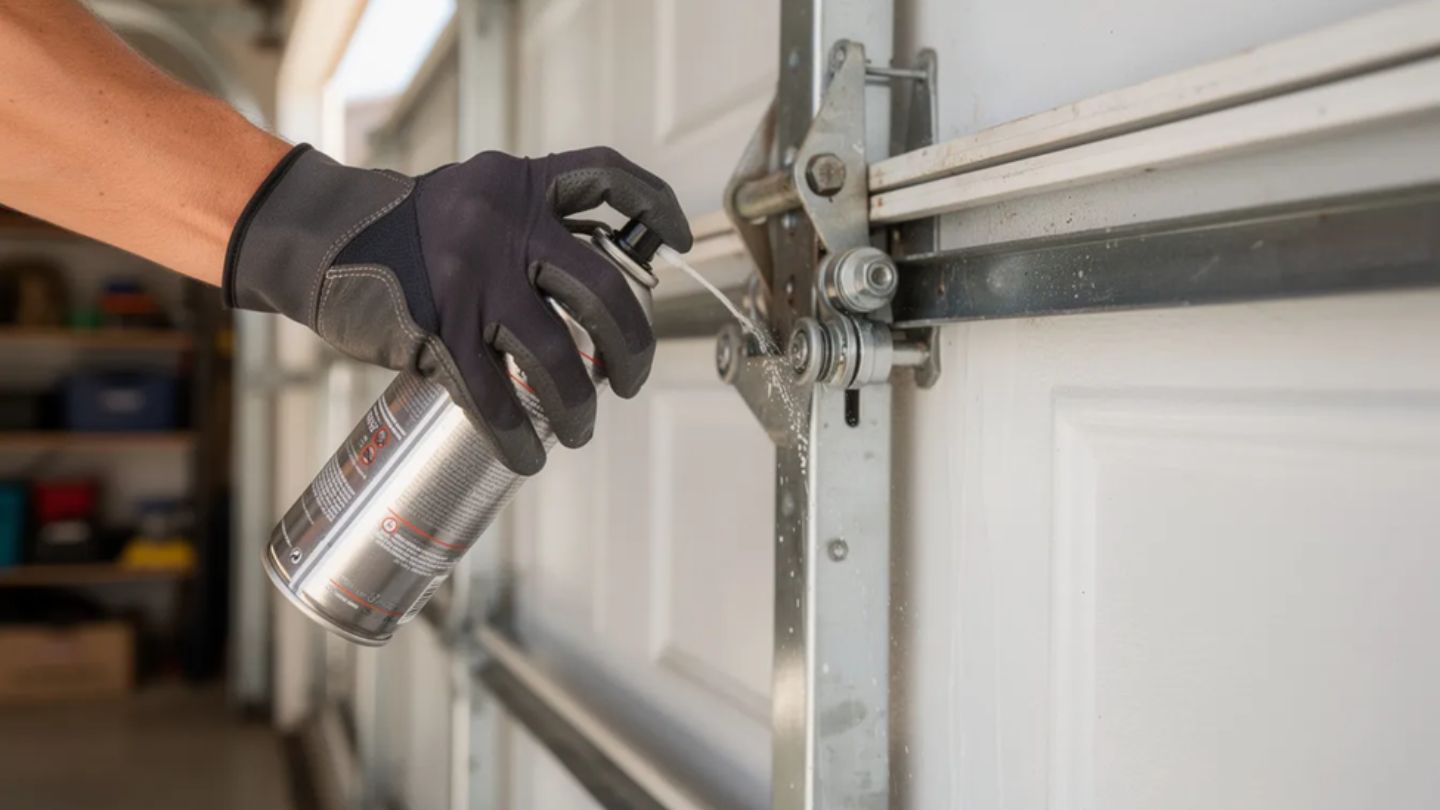
Most sudden failures trace back to neglected maintenance, lack of lubrication, ignored noises, or springs reaching the end of their cycle life. A little attention goes a long way toward keeping your garage door working reliably.
|
Task |
Frequency |
Notes |
|
Inspect springs and cables |
Yearly |
Look for rust, fraying, or visible damage |
|
Check track alignment |
Yearly |
Look for gaps, loose brackets |
|
Test photo eye sensors |
Yearly |
Both LEDs should show solid lights |
|
Replace remote batteries |
Every 1-2 years |
Don’t wait for complete failure |
|
Lubricate moving parts |
Twice yearly |
Rollers, hinges, spring coils |
|
Professional tune-up |
Every 1-2 years |
Especially for high-use doors |
For businesses and high-traffic facilities, the importance of professional service is even greater. Many commercial properties benefit from understanding the benefits of using a commercial garage door repair service, where downtime and safety risks carry higher stakes.
Use a garage-door-specific or silicone lubricant on:
Avoid: WD-40 (it’s a solvent, not a lubricant) and spraying the tracks directly.
Lubricate before winter freezes if you live in colder climates. Cold temperatures thicken lubricants and can cause binding.
Perform this test once or twice a year:
A properly balanced door should stay roughly in place. If it drifts up quickly or drops down, the springs may need adjustment by a professional.
New noises during operation, grinding, squealing, and popping are early warning signs. Don’t wait for the door to fail completely. Address unusual sounds promptly to prevent minor issues from becoming major repairs.
A garage door that won’t go up is frustrating, but most problems trace back to a handful of common causes: broken springs, power or sensor issues, engaged locks, or opener failures. By starting with simple checks and knowing when to stop and call a professional, you can protect your safety, avoid further damage, and get your door operating reliably again.
If troubleshooting points to a mechanical or opener-related issue, Dayton Door Sales is a trusted local expert for garage door repair in Kettering that homeowners rely on. In addition to serving Kettering, they proudly provide service in surrounding areas, including Tipp City, Bellbrook, and Beavercreek. We also specialize in patio entry doors in Kettering and Springboro, delivering dependable solutions backed by experienced technicians and quality workmanship.
Why does my garage door only open a few inches and then stop?
This usually means a broken spring, an engaged manual lock, or the opener detecting resistance. Check for locks or obstructions first. If the door feels extremely heavy, the spring has likely failed.
My garage door goes up manually but not with the opener, what’s wrong?
If the door lifts easily by hand, the issue is likely inside the opener. Common causes include a stripped gear, bad capacitor, failed motor, or remote/wall control problems rather than door hardware.
Can cold weather in January or February stop my garage door from going up?
Yes. Cold temperatures thicken lubricants, cause metal contraction, misalign sensors, and make older springs brittle. These factors increase resistance and can trigger safety shutoffs or cause spring failure during winter months.
Is it safe to leave my garage door partially open if it’s stuck?
No. A partially open door can fall suddenly if springs or cables fail. Never walk or park under it. If you can’t close it safely, secure it in place and call a professional immediately.
How long do garage door springs and openers typically last?
Garage door springs usually last 7–15 years depending on usage, while openers typically last 10–20 years. Homes with frequent daily use should expect shorter lifespans and more frequent maintenance or replacement.
.jpg)


